

Two Partisans for Peace: In the foreground is Dom Pierluigi of the Balducci Center and a parish priest in Zugliano, in the background is the oldest living partisan in the region speaking on defending democracy then and now. Photo credit: Mary Bricker-Jenkins.
By Mary Bricker-Jenkins
Chair, Poor People’s Campaign Ad Hoc Committee
The Poor People’s Campaign: A National Call for Moral Revival is the proverbial seed blowing in the wind, taking root wherever it lands.
I just returned from northern Italy, where I was invited to introduce the campaign at Sunday Mass in Zugliano and to the community of the Ernesto Balducci Center. For thirty years, the “centro” has housed refugees and asylum seekers and hosted international dialogues to promote peace. The Balducci Center, along with over 40 other international organizations, has now formally partnered with the campaign.
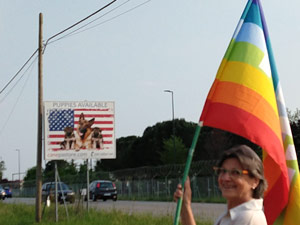 In turn, I was invited to participate in a peace vigil on April 25, Liberation Day—a national holiday commemorating the Allied victory in Italy. Organized by three priests and their congregations, the vigil was held at the Aviano Air Base, a NATO facility housing the USAF’s 31st Fighter Wing and support operations.
We gathered in a field opposite the entrance to the base—in the shadow of a billboard offering free German Shepherd puppies from the USAF to the community. Yes, free puppies.
Introduced as a member of WILPF and the Poor People’s Campaign, I was asked to say a few words. Here’s a summary of what I said:
This is a special day for me personally because I had several uncles who participated in the liberation. They returned to the USA proud to have been part of what they believed would be the last war. Believing that they had helped create a world of peace, they heralded the establishment of the United Nations. It wasn’t long before they realized that the institution would not be the instrument of world peace that they had hoped for. They helped me understand that we—each of us individually, working together—had to become the united nations that would create a world of peace. So let us join hands and, in silence, be grateful to all those who died in war with hopes of a world at peace in their hearts. . .and be grateful that we can be here, working to be the nations united to fulfill their hopes and dreams of peace.
Many formal presentations followed, and many more stepped forward to share their thoughts, proposals, and commitments. Among the more inventive was a petition to the Pope to ask that the famous Vatican Swiss Guards be disarmed, though the proponent acknowledged the immense tourist value of the corps. Among the most moving comments were those delivered by the last living partisan in the region. In the shadow of the mountains where he and his comrades found and hid lost and injured allied soldiers, he spoke of their sacrifices for democracy and the need to recognize and resist the rising contemporary threats to democracy. Among the most inspiring was a spontaneous address that began, “I represent no institution, no group, no organization. I came here today because I am a woman and a mother. . .” Having limited Italian, I understood little of what she said after that, but to me she had said all that needed to be said in those few words—“I am here because I am a woman and a mother.”
Following the vigil, we stopped in nearby Pordenone for a soft drink. The signs of the military economy were everywhere, from the Pepsi ads to the US war propaganda. In this town there was no need to buy loyalty with free puppies. It was clear that the local economy depended almost totally on the presence of US and NATO forces at the base. Exhilarated by the spirit of the vigil, I was nevertheless struck by the enormity of our task: nothing less than the total conversion of the war economy to the production of peace.
Still, sharing a mint water with the leaders of the Italian peace center that had just signed onto the Poor People’s Campaign, everything seemed possible. Is possible.
Inset photo: Graziella Castelano, VP of the Balducci Center, with Peace flag responding to USAF’s offer of free puppies. Photo credit: Mary Bricker-Jenskins.

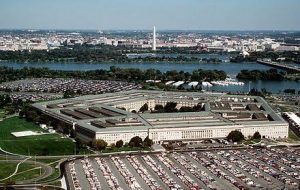 Even though the focus of the Poor People’s Campaign is on conditions in the U.S., let’s be clear about what the content of our conversation must be when we discuss the topics of Weeks Three and Four. Militarism at home is projected worldwide, funded by a war economy that prevents spending that would meet human needs here and worldwide, and has devastating environmental and health impacts. So when it comes to a “national call for moral revival,” we cannot avoid talking about U.S. militarism worldwide.


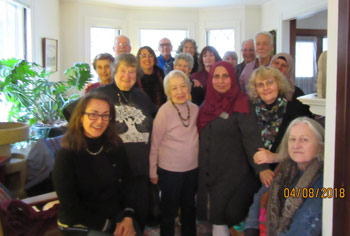 On April 8, twenty people came to Joan Eklein’s home in Newton, MA, to hear the stories of two Palestinian women struggling to make a living while living under Israeli control. The bilingual women brought lovely jewelry and needlework scarves and shoulder bags to sell.
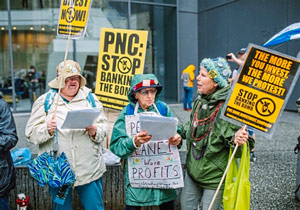 On Tuesday, April 24, Pittsburgh WILPF participated in a protest in front of PNC Bank during their shareholders meeting to demand that the bank stop lending money to manufacturers of nuclear weapons. A photo of the Raging Grannies appeared in the Pittsburgh Post-Gazette on 4/25/18.


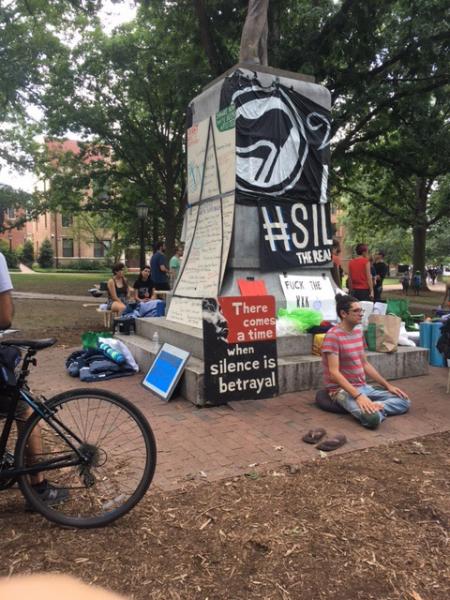 Reacting to the Virginia tragedy, the Republican-controlled NC legislature passed a law prohibiting the removal of historic monuments on public property. Following days of protests at the site of the UNC monument in August 2017, the university's chancellor in Chapel Hill and the president of the university system petitioned Democratic Governor Cooper for a ruling on the removal of the monument. The governor immediately offered support for relocating the monument for safety concerns but the action was delayed by the university board of governors in deference to the legislature by which they were appointed.
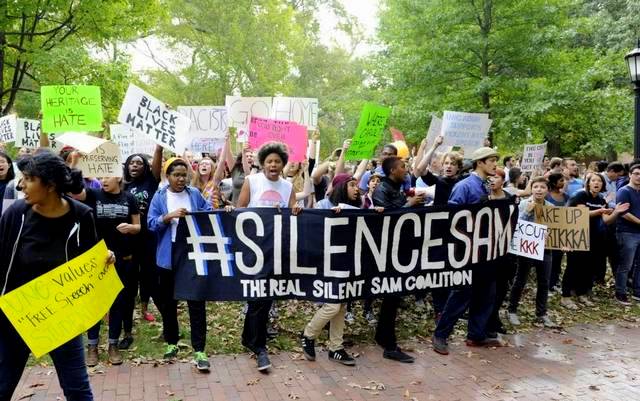 The state Historical Commission has been charged with reviewing legal and historical data regarding the potential for moving monuments on the state Capitol grounds. A recent public hearing brought forth a contingent of Confederate veterans groups expressing that moving the monuments would be an insult to all veterans. The presence of the monument at the entry to the campus is a constant reminder to the African American community of the esteem with which some whites still hold the old South. It pays homage to a time when the South chose to leave the union in order to support the enslavement of fellow humans to maintain a way of life. It was dedicated at a time when the assertion of white supremacy was violent and merciless. It was anything but patriotism and the statue should certainly not be a point of celebration at this time. To allow this to occupy a place of honor at our state's flagship campus of the university system envelopes us in a cloud of shame.